Major obstacle to the fight for equality for women in Pakistan.
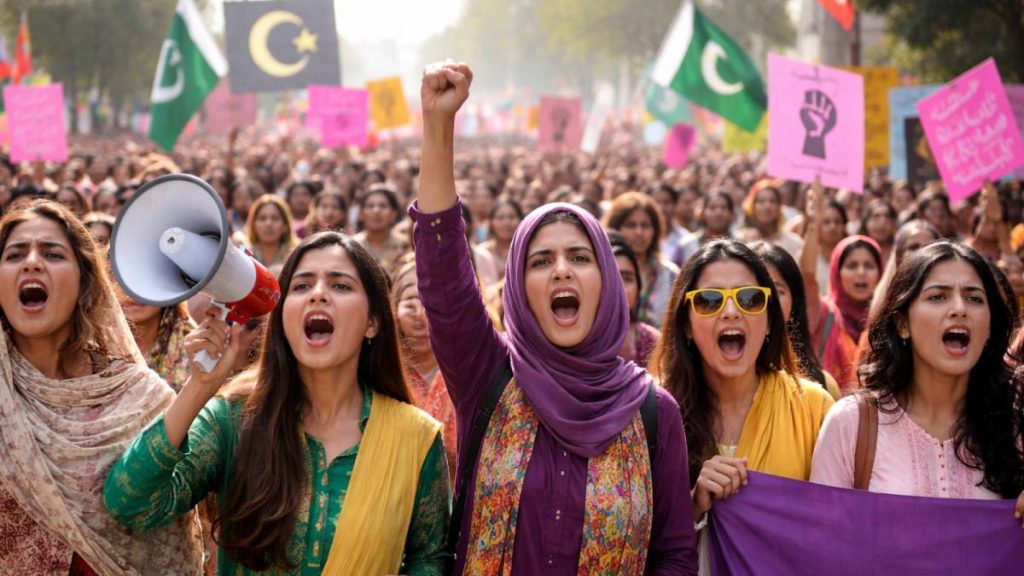
Major obstacle to the fight for equality for women in Pakistan.
By Muhammad Bilal
A young woman who was my distant cousin was killed by her uncle because she was allegedly texting a ghair mard (a man who wasn’t her relative). The police buried the case. There were no hashtags, no news, no advocacy for justice. Maybe if we did have access to online spaces, there would’ve been more outrage,” says 20 year old Maryam Jamali, who runs Madat Balochistan, an organization working for development in Balochistan and Sindh, in the south of Pakistan.
There are many examples of how the digital divide is holding back women in Pakistan. In this country, the fifth most populous in the world (with 220 million inhabitants), half of the population has some form of internet access, according to the NGO Bytes For All, but it is one of the nations with the most pronounced digital gender gap on the planet, with 26% of women having internet access, compared to 47% of men, according to World Bank data. In addition, only 50% of Pakistani women own a cell phone, compared to 81% of Pakistani men, and women are 49% less likely to use mobile internet than men, according to the United Nations Development Programme (UNDP). These gaps widen in rural and low-income communities, where patriarchal structures and limited resources make access even more difficult. There, only 7% of women (compared to 20% of men) have access to the Internet, according to the World Bank.
The problem of women’s lack of access to the Internet sometimes starts in childhood.
Digital rights expert Hija Kamran, whose work has focused significantly on gender and digital rights says that amidst her research she came across the case of a young girl who was asked to no longer attend her online classes at home if her brothers wanted to play video games. The fact that video games were given more preference over her classes says a lot about the way in which women’s right to literacy and online spaces is perceived. In this case, it can be easy to neglect this young girl’s restrictions because she’s in a house with access and is even registered for online classes, in itself a privilege in a country with a 58% literacy rate, a percentage that drops to 46% in the case of women, according to World Bank data.
When women’s access is restricted, along with their ability to learn how to use online spaces safely, they become vulnerable to both misinformation and cyber-harassment. Internet users with very controlled or limited access will find it more difficult to learn how to use Internet content safely, and become vulnerable to both misinformation and cyberbullying, experts warn. Forty percent of Pakistani women have experienced some form of online harassment, according to a study by the Digital Rights Foundation. In a society where ‘morals’ are often touted as a reason to control women’s actions, these risks become a reason for people to police women’s digital access instead of educating them further. Perceptions around apps like TikTok being ‘immoral’ may become a reason for further control as well.
This statistic alone highlights how dire the situation is for Pakistani women compared to the rest of the world. While laws exist, enforcement is weak, and access to justice is poor.